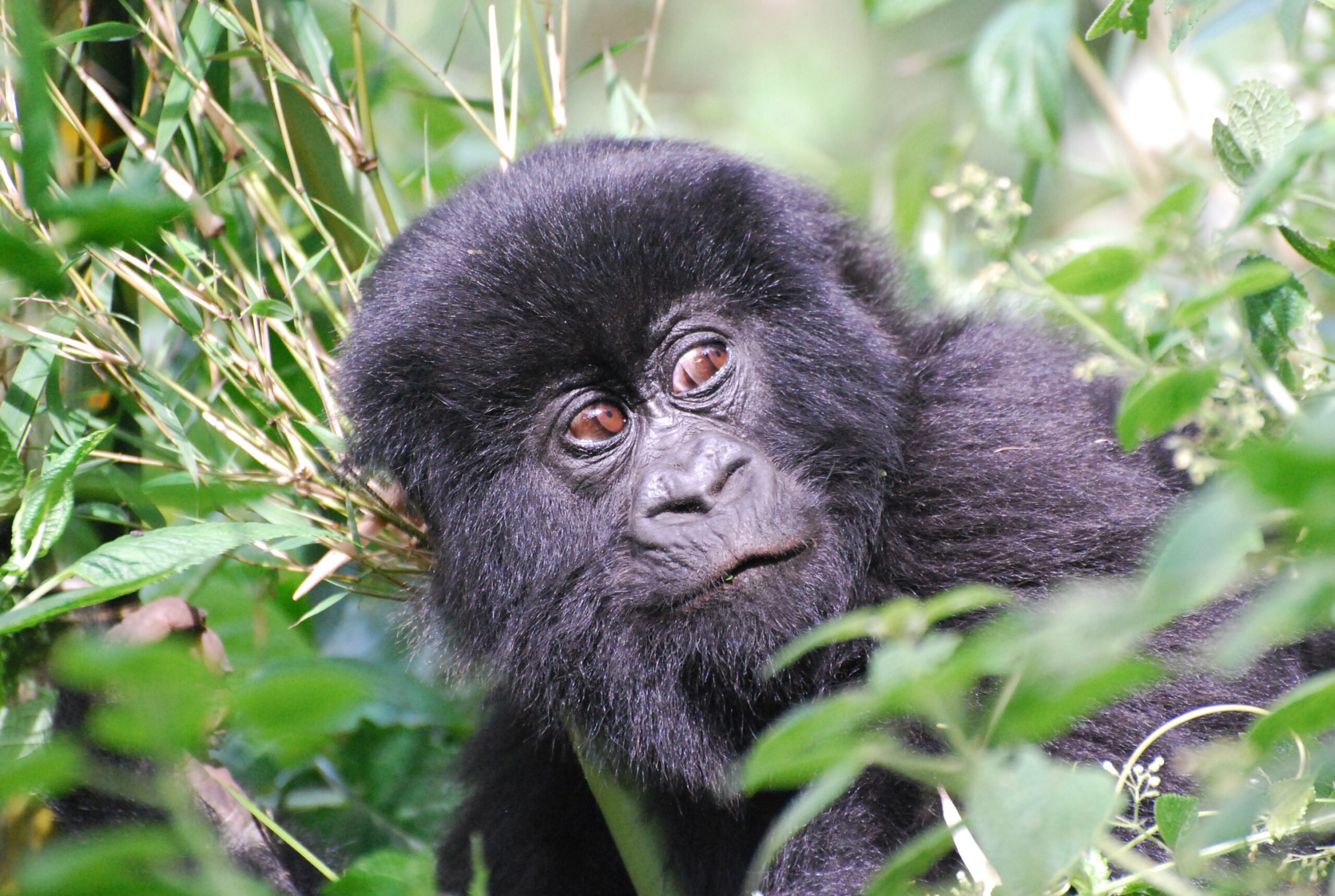

As a Mountain Gorilla Doctor for more than 22 years, I conducted thousands of field interventions on gorilla and other wildlife animals. I recall a particularly challenging field intervention with our team in Pablo’s group, when I was called to help Infura, an infant gorilla caught in a snare. Park trackers had reported the situation and called us in to assess and plan for snare removal.
The day before our arrival, experienced trackers had managed to cut part of the rope with a machete, allowing Infura to rejoin his group. However, about a meter of rope remained tightly tied around his leg, and he was clearly in pain.
During our first intervention attempt, the group was aggressive — not unusual when one of their members is distressed. Mountain gorilla veterinarians must carefully observe the group and select the safest moment to act. Because of the group’s agitation, we decided to postpone the snare removal, prioritizing safety for both the gorillas and our team.
After a heavy rain that day, the group calmed down, and we prepared for a second assessment. I had my tranquilizer dart ready, but Gicurasi, one of the silverbacks, grew suspicious as he noticed the trackers following Infura. He suddenly charged and bit one of our best trackers, Jean Bosco Ntirenganya, on the shoulder.
Jean Bosco, a highly skilled member of the DFGFI team, received immediate first aid from our team. We quickly discussed the situation and decided to withdraw to avoid further stress or injury. Four trackers were assigned to observe the group from a distance and report back on where the gorillas would nest for the night.
The incident had visibly distressed the group. Trackers later observed several gorillas trying to help Infura remove the rope, but their attempts only frightened him more and worsened his condition.
Although gorillas are generally gentle animals, they can become aggressive when protecting their group and responding to perceived threats. This behavior is especially challenging in larger groups that include multiple silverbacks — sometimes as many as five — making interventions more complex and risky. I contacted the late Dr. Tony, Head veterinarian at RDB to discuss our plan. We all agreed to postpone the intervention again, to prevent further incident and avoid putting our team at risk.

Thankfully, Jean Bosco recovered well and was taken to the hospital for proper medical care.
The next day, the group had spread out. Infura was with his mother Ishema, and another female, both staying close to Gicurasi, the silverback. Though Infura managed to move and feed, it was clear he was in pain. The rope had tightened, causing visible swelling. Every time it caught on vegetation, Infura screamed in pain, while Ishema remained by his side, guiding and supporting him. Gicurasi remained tense, often grunting at trackers. Cantsbee, the dominant silverback, was not nearby at the time.
Eventually, with the continued collaboration and support by trackers, we were able to conduct a successful intervention and remove the snare.
Each year on July 31st, OHAC/Gorilla Health joins the global community in celebrating World Ranger Day — a day dedicated to honoring the dedication and bravery of trackers and rangers who support our work with endangered mountain gorillas and captive gorillas in Volcanoes National Park.
This day carries particular significance in the Democratic Republic of Congo (DRC), where more than 150 park rangers have lost their lives while protecting wildlife and natural heritage.
Dr. Jean Felix Kinani Sangwa, who has worked closely with many of these courageous individuals, reflects on their vital role:
“Park Trackers are not only gorilla guardians of national parks and biodiversity; they are also the first to detect early signs of illness in wildlife — especially gorillas — allowing timely intervention and treatment by us, mountain gorillas doctors.”
By
Dr Jean Felix Kinani Sangwa – One Health Approach for Conservation (OHAC) – Gorilla Health
For more information or if you would like to make a donation, we greatly appreciate it.
You can contact our organization via by email: info@gorillahealth.org/ ohac2004@gmail.com
www.gorillahealth.org – Tel: 0788640986